How Thermal Analysis Shapes Material Quality
At Orthoplastics, we pride ourselves on setting the benchmark for quality and precision in the manufacture of medical-grade polymers. As a leader in Ultra High Molecular Weight Polyethylene (UHMWPE), we use advanced testing methods to ensure every material we produce delivers consistency, reliability and long-term performance.
One of the key techniques for evaluating material properties is Differential Scanning Calorimetry (DSC), which provides valuable insight into how a polymer behaves under changing temperature conditions.
What is DSC testing?
Differential Scanning Calorimetry measures how a material absorbs or releases heat as its temperature changes. For UHMWPE, this test reveals essential thermal characteristics, such as the melting points (Tp / To) and heat of fusion (ΔHs).
These parameters enable our team to assess the polymer's internal structure and predict its performance in demanding medical applications.
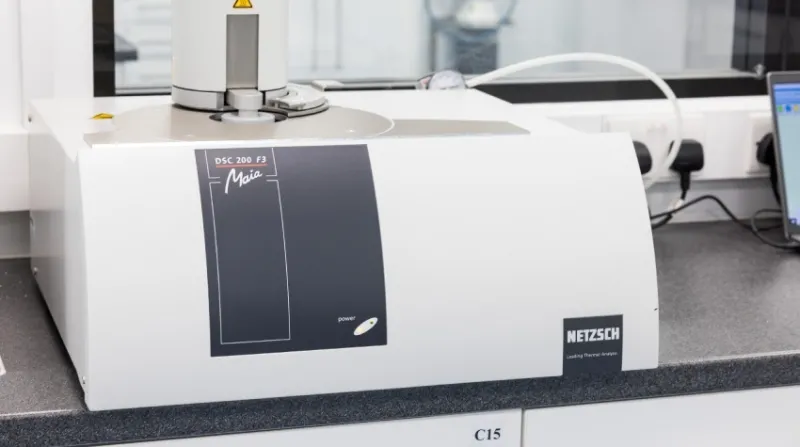
At Orthoplastics, DSC testing is carried out on UHMWPE and in accordance with ASTM F2625 using a Netzsch DSC 200 F3 Maia and our ISO17025 accreditation. Each test starts by heating a small, carefully prepared sample past its melting point and recording how it absorbs heat.
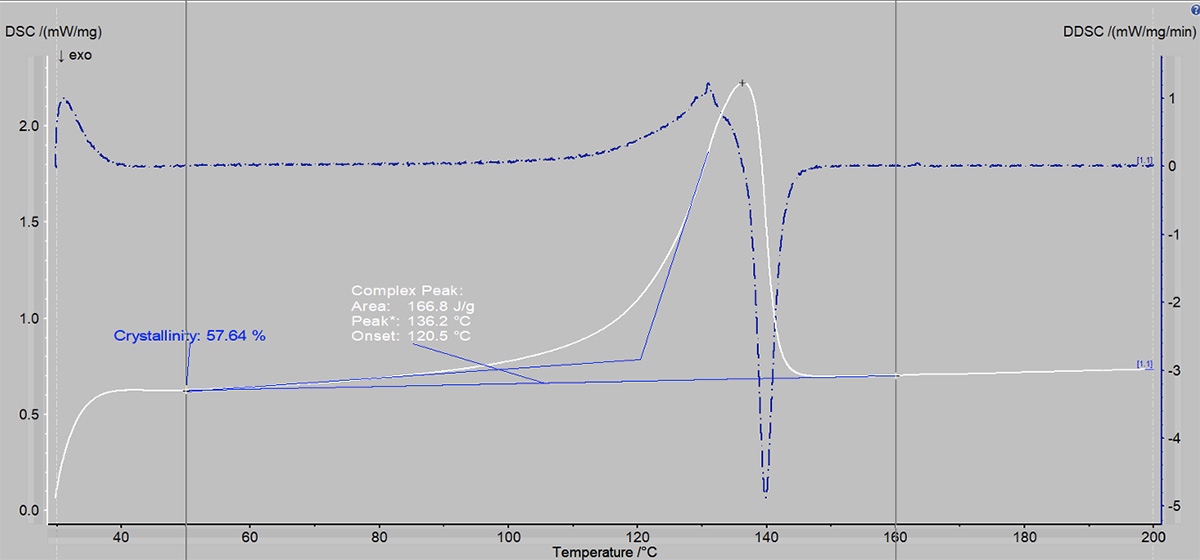
The curve produced (as in the graph below) shows how the specific heat flow rate changes as the sample material temperature increases above its melt temperature. This allows our engineers to measure its crystallinity and gain a deeper understanding of the material’s structure.
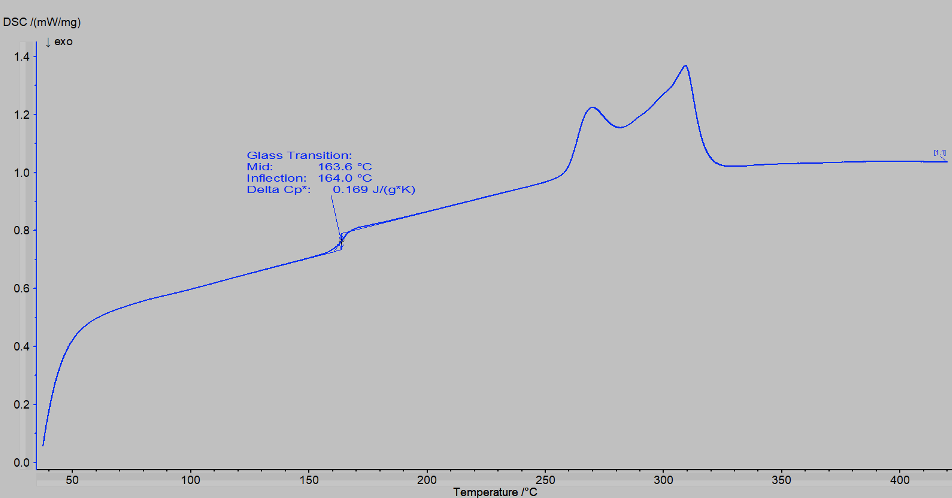
Orthoplastics can also conduct DSC testing on any polymeric material in accordance with ASTM D3418*. In polymeric materials that will be exposed to elevated temperatures during their working life, this can yield useful information to indicate the expected material performance.
*Note: Testing to ASTM D3418 falls outside of Orthoplastics Testing Laboratories’ UKAS accreditation schedule.
What the results show
When designing with polymeric materials for elevated temperatures or applications requiring controlled deformation, knowledge of properties such as the glass transition temperature is essential for appropriate material selection. As materials transition from the “glass” state (below Tg) to the “rubber” state (above Tg), the polymer molecules will have greater mobility and the material’s mechanical properties will change accordingly.
The DSC curve acts as a thermal fingerprint of UHMWPE. It identifies three critical values: the onset temperature, the peak temperature and the heat of fusion. These figures define how the polymer transitions from solid to ‘liquid’ and reveal the degree of order within its molecular structure.
A typical result from Orthoplastics UHMWPE shows a complex melt peak with an onset at ~120 °C and a maximum peak at ~136 °C, crystallinity can range from ~45% to ~70% depending on the grade, additive and processing conditions of the UHMWPE.
This range of crystallinity demonstrates a highly stable material that combines mechanical strength and wear resistance, making UHMWPE the primary choice for a wide range of long-term orthopaedic applications.
Why DSC analysis matters
The relationship between thermal behaviour and material performance makes DSC an invaluable tool in the quality assurance and analysis of polymers. By analysing the heat flow and melting characteristics of UHMWPE, we can:
- Verify that the material meets specification and performs as expected.
- Assess how manufacturing or sterilisation processes influence material performance.
- Support validation data for regulatory and performance requirements.
- Enable you to make the right choice of material for your usage needs.
- Evaluate the impact of additives & reinforcement materials.
- Assess thermal stability.
Understanding these characteristics helps us ensure that every product we manufacture meets the highest standards of strength, stability and longevity.
Delivering confidence through precision
Every Orthoplastics product is supported by a rigorous testing programme that combines scientific expertise with decades of polymer manufacturing experience. Our in-house DSC testing gives customers confidence that each component has been validated against precise material data, not assumptions.
By studying how thermal analysis shapes material quality, we continue to push the boundaries of polymer science and maintain our position as a trusted global partner in medical-grade polymers.
Find out more
To learn more about our DSC testing capabilities or how Orthoplastics can support your Polymer Testing requirements, please contact our technical team via the Orthoplastics laboratory website.
Go Back