Crosslinking & Crosslinked Polyethylene
Industry leading research and development
A direct consequence of industry leading research and development activities has allowed Orthoplastics to successfully ensure that they have the capability to manufacture crosslinked UHMWPE.
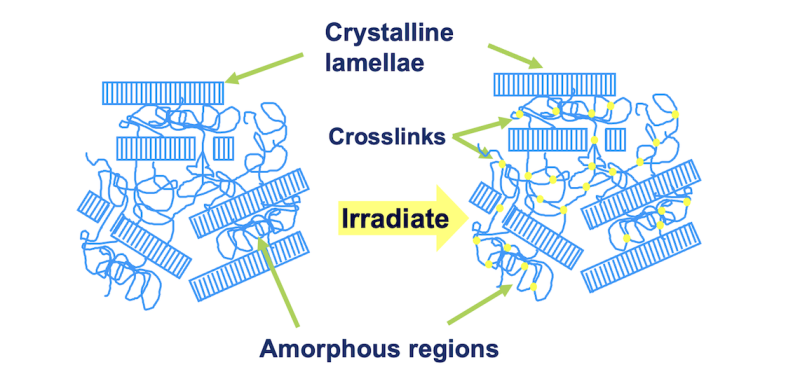
The benefit of manufacturing UHMWPE in this manner, is a significant reduction in wear on the medical application. By using a process which exposes standard UHMWPE to ionising radiation, it allows Orthoplastics to produce a higher grade of UHMWPE, otherwise referred to as Crosslinked UHMWPE, bringing major benefits to medical implant manufacturers, and the patient community.
The process of Crosslinking UHMWPE
To achieve crosslinking, UHMWPE is exposed to ionising radiation, usually either an electron beam or a gamma source, commonly Cobalt 60. In order to carry out this process of crosslinking UHMWPE, two important control factors must be in place; dose level and oxidat
Firstly, dose level is critical to the residual mechanical strength, which decreases as the dose quantity rises. Controlling this process is critical for ensuring batch to batch, and part to part consistency.
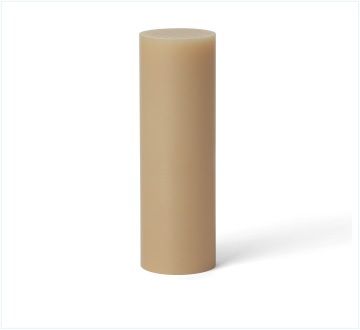
The second stage of crosslinking UHMWPE is oxidation. This process is the direct outcome of generating free radicals after exposure to ionising energy. Oxidation is dealt with by firstly annealing or re-melting soon after irradiation and then removing the newly exposed surface of the rods by only a few millimetres.
Crosslinking uniformity
Over many years, Orthoplastics has developed and validated our crosslinking process to achieve tighter dose distribution; these studies have resulted in greater product uniformity and performance characteristics.
Using selected vendors for e-beam, gamma and x-ray crosslinking, we can manufacture bespoke crosslinked variants for OEM’s across the world, to optimise material performance for each orthopaedic design.
Frequently Asked Questions
We’ve answered some of the most common queries about our materials including performance, processing, applications and more.
Why is crosslinking used in UHMWPE materials?
Crosslinking is used to enhance the wear performance of UHMWPE. By modifying the internal structure of the material, it helps improve durability in applications where surfaces are in constant motion or contact.
How does crosslinking affect material performance over time?
Crosslinking can improve long-term performance by increasing resistance to wear. This makes the material more suitable for applications where maintaining surface integrity is critical over extended use.
What are the key considerations when selecting crosslinked UHMWPE?
Key considerations include the level of crosslinking required, the intended application and the balance between wear resistance and other mechanical properties. Selecting the right specification ensures optimal performance.
How is crosslinked UHMWPE used in manufacturing?
Crosslinked UHMWPE is used in applications where improved wear characteristics are needed. It is typically processed into components that require long service life and consistent material behaviour.
What are the benefits of working with a specialist in crosslinking?
Working with a specialist ensures that the crosslinking process is carefully controlled and aligned to application requirements. This helps deliver consistent material performance and reliable quality for end-use components.